Beginner's Guide to Macro Photography of Forest Insects
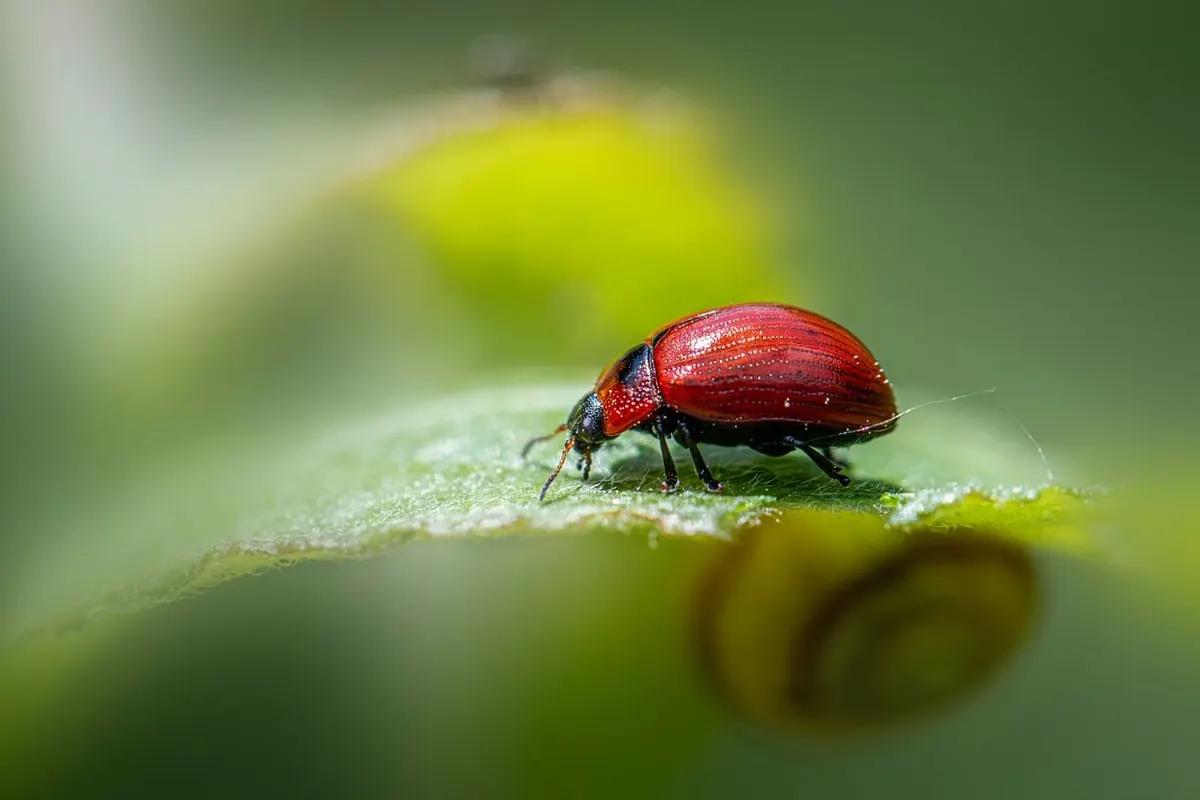
Forest macro photography rewards a particular temperament: someone willing to kneel in wet leaves, wait longer than feels reasonable, and come home with four good frames instead of four hundred careless ones. Under a single rotting branch there can be more subjects than most people photograph in a month, and almost none of them will hold still while you set up a tripod. The encouraging part is that the barrier to entry is low. A modest macro lens, a diffused flash and the patience to slow down will take you further than expensive glass. What follows is a working method for the settings, the positioning, the waiting and the handling.
You do not need a specialist rig, but a few items earn their place in the bag every time. A true macro lens in the 60–105mm range is the classic choice; longer focal lengths give you more working distance, which matters enormously with skittish subjects like beetles and resting damselflies. If a dedicated macro lens is out of reach, extension tubes on a 50mm prime will get you close for very little money, at the cost of light and convenience.
Forest floors are dim, and the light changes metre by metre. Work in manual mode so the camera stops second-guessing you between frames.
Depth of field at close range is measured in millimetres. Open up to f/4 and you may get an eye and nothing else sharp; stop down past f/16 and diffraction starts to soften the whole frame. Most forest insect work sits comfortably between f/8 and f/13. If your subject is perfectly still and you want the whole animal crisp, focus stacking — shooting a sequence of frames at f/5.6 and blending them later — is the reliable route.
With flash as your main light, think in terms of the flash duration rather than the shutter speed. Set the shutter to your camera's sync speed or a little below — commonly around 1/160 to 1/250 sec — and let the flash freeze the subject. Start with the flash in manual at about 1/8 to 1/16 power and adjust distance and power together. Keep ISO low, around 200–400, to hold onto detail in the shadows. On overcast days, a burst of two or three frames gives you insurance against the tiny movement that ruins an otherwise good shot.
Autofocus at 1:1 is a negotiation, not a guarantee. Use a single focus point, set the lens to its focus limiter if it has one, and switch to live view with magnification for stationary subjects. Many experienced shooters focus manually and move their whole body a few millimetres forward and back until the eye snaps into focus. It feels clumsy for an afternoon and then becomes second nature.
Most soft insect photographs are not a lens problem. They are a posture problem. Get low — genuinely low, chest or chin near the ground — and brace the camera on something solid: a beanbag, your knee, a folded jacket. Tuck your elbows in. Breathe out slowly and press the shutter in the pause at the bottom of the breath.
Approach from the shadow side so your own silhouette does not fall across the subject, and watch where you put your hands. A tripod with a short, reversible centre column is useful for fungi and slow caterpillars, but for active insects a beanbag plus good bracing usually wins on speed. Whatever you use, check your background before you commit: a small shift of angle can turn a tangle of twigs into a clean dark wash.
Early morning is the generous hour. Overnight dew and cool air leave many insects torpid and easy to approach; a damselfly that would vanish at noon may sit through a whole session before the sun reaches it. Walk slowly, scan rather than stride, and stop the moment you notice movement. Then watch for a minute before you raise the camera — you will learn which way the animal turns and how close it tolerates.
Approach in small increments, pausing each time the insect shifts. Rushing the last thirty centimetres is what costs you the frame. It also pays to return to the same log, the same flowerhead, the same patch of bark across a season; you start to know where the residents are.
Macro work is mostly waiting, and the waiting is where the pictures come from.
At these magnifications your flash is a point source unless you intervene. Keep the diffuser as large as is practical and as close to the subject as you can get without entering the frame; that softens the highlights on shiny carapaces and fills the shadows under leaves. Bare direct flash produces hot specular blobs and hard black shadows that read as harsh even in an otherwise gentle woodland scene.
Look for backlight, too. A leafcutter bee or a translucent caterpillar lit from behind glows in a way no frontal flash can imitate; use a pale leaf or a piece of white card as a reflector to lift the shadow side. And separate your subject from its backdrop: shoot along the ground rather than down at it, and a distant patch of moss becomes a soft green field instead of a busy pixel mess.
The subject is a living animal with a short and hazardous life, and your photograph is not worth shortening it. The sound practice is simple: do not chill insects in a cooler to slow them down, do not handle them for a better angle, and never move an insect far from where you found it. Invertebrates desiccate quickly and lose their footing on unfamiliar surfaces.
Skip baiting with sugar water or honey. It attracts ants, encourages unnatural crowding and can spread disease between individuals. If something blocks the frame — a blade of grass across a spider's web, say — move the vegetation gently or change your angle rather than the animal. Roll logs back exactly as you found them, replace stones, and keep off moss cushions that take years to recover. Flash is fine in moderation, but a dozen close bursts on one subject is stress, not craft.
Some reserves and protected sites restrict flash, off-path access or the handling of certain species. Read the signage or ask the warden before you assume; it is a two-minute conversation that keeps access open for everyone.
Take your time, take fewer frames, and leave the log as you found it. That combination, more than any setting, is what produces forest insect photographs worth keeping.
Photo: Erik_Karits / Pixabay
Previous Post
A Seasonal Guide to Photographing Bluebells in English Woodlands
Next Post
Understanding Histograms in Forest Photography: An Explainer for Contrasty Scenes