A Seasonal Guide to Photographing Bluebells in English Woodlands
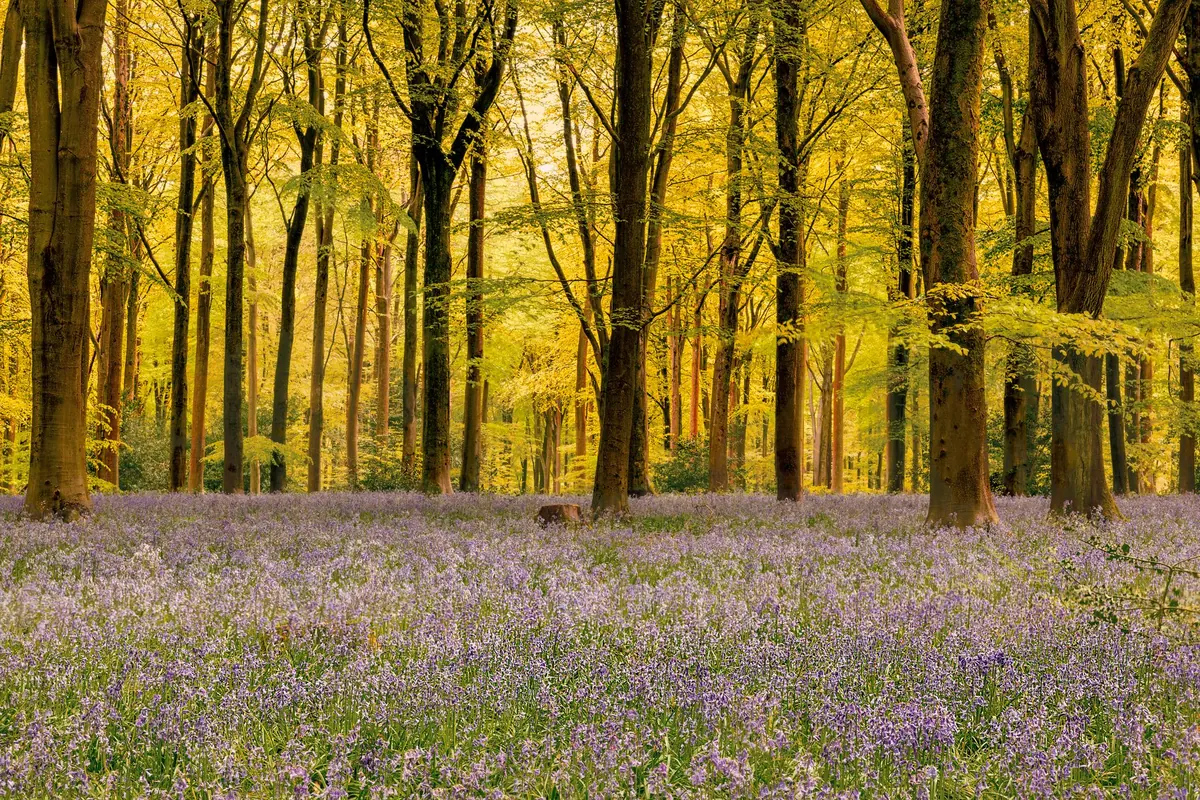
Bluebell woods arrive quietly. One weekend the floor is still brown leaf litter and wood anemone; the next it has gone a deep, slightly unreal blue that turns out to be surprisingly hard to photograph. The window in any single wood is short — often three weeks, sometimes less — and it shifts across the country as the spring moves north. What follows is how to find that window, how to shoot it well, and how to leave the flowers standing for the people and the bees that come after you.
Native bluebells (Hyacinthoides non-scripta) follow the warmth. Sheltered valleys in Devon and Cornwall can be at their best in mid-April, while woods in the Chilterns, the Weald and the Welsh borders usually peak from late April into early May. Upland woods in the north of England and Scotland may hold on until the middle or end of May, and a cold spring can push everything back by a fortnight.
Two local factors matter as much as latitude. Altitude delays flowering, so a wood two hundred metres higher than a valley five miles away might be ten days behind it. Aspect matters too: south-facing edges open first, and the middle of a dense wood lags behind its sunny fringe. If you have one site in mind, plan two visits — a reconnaissance walk a week or so before you expect the peak, then a shooting trip when the reports look right.
Read the flowers rather than the date. At peak, the lower bells on each spike are open while the stem is still upright and the whole wood reads as a continuous haze from a distance, not as separate clumps. Bluebells flower in the gap between the last frost and the closing canopy, which is why fresh green leaves and blue flowers arrive together. A wood that is already deep, dark green underfoot and overhead has probably gone over.
Bright sun is the enemy of a bluebell carpet. It punches highlights into the glossy leaves, buries the flowers in shadow and gives you a contrast range no sensor will hold. A bright overcast day is far better: even light, deeper colour, and detail in every flower. Failing that, work in the first hour after sunrise or in the last of the evening, and look for wood edges where low light comes through the trunks from behind. Backlit bluebells glow, and a single translucent flower against a dark trunk can be worth more than another picture of the whole floor.
Wind matters more than most photographers expect. Bluebells stand tall on thin stems, and even a light breeze sets the whole carpet shivering. Early morning is usually calmest, and hollows or the sheltered side of a bank are calmer than open rides. If it is blowing, either raise your shutter speed and accept a slightly higher ISO, or give up on the wide shot and find one sheltered stem.
Bluebells are awkward colour. They can come out purple, neon or flat, and the blue channel clips more easily than you think. A few habits will save the files.
Worth knowing what you are photographing, too. Native bluebells have narrow bells on one side of a nodding stem, a deep violet-blue that leans purple in shade, and a strong sweet scent. Spanish bluebells and their hybrids are paler, more open-belled, carry flowers all round an upright stem and barely smell. Both are photogenic; only one belongs in an ancient wood.
The commonest mistake is standing up and shooting down. A bluebell carpet photographed from eye level looks like a rumpled rug. Get the lens to flower height and the wood opens up into layers, with stems in the foreground and blue haze behind.
Do it without lying in the flowers, though. Kneel on the path with a mat or your bag under you, or use a small tripod with the legs splayed low and the centre column dropped or removed. A camera with a tilting screen helps enormously: hold it low over the path edge, angle it up, and you get the low viewpoint without touching a single plant. If the perfect angle only exists in the middle of the carpet, that angle is not available.
Low angles flatten your depth of field quickly. For the wide shots, stop down to f/8 or f/11 and focus roughly a third of the way into the frame. For close work, three to six frames focused at different distances, blended later, will hold the whole flower sharp while the background melts.
A bluebell leaf that is crushed in April cannot feed the bulb for next year, and a compacted patch of woodland floor takes a long time to recover. Multiply that by a few hundred visitors in a popular wood and the damage is visible from one season to the next. Wild bluebells are also protected from being dug up in England and Wales, and at many reserves picking is prohibited as well.
Charge the battery the night before and pack a spare card, a polariser, a cloth, a kneeling mat and footwear with grip — wet bluebell woods are slippery. Check the forecast for wind speed as well as cloud, and aim to be in the wood at first light. Give yourself a time limit so you do not drift off the path while chasing one more frame. Then, before you leave, look back along your route: if the only mark you have left is a set of footprints on the path, the wood will be worth returning to next spring.
Photo: Bob Jenkin / Pexels
Previous Post
Common Mistakes on Woodland Photography Walks (and How to Fix Them)
Next Post
Beginner's Guide to Macro Photography of Forest Insects