A Local Angle: Photographing the Same Woodland Through Four Seasons
The first time you walk into a wood, you photograph the wood. The tenth time, you photograph the light on a particular beech trunk, the way a fallen branch has settled, the gap where the path floods every March. That shift — from recording a place to reading it — is the whole reason to keep going back to the same patch of trees instead of chasing new ones. Pick a wood within half an hour of home, decide on four or five viewpoints, and give yourself a year. The series will assemble itself.
Proximity is not a compromise; it is the point. A wood forty minutes away gets photographed three times. A wood ten minutes away gets photographed in fog before work, after rain on a Sunday, and in the flat grey hour when nothing seems promising and the frost turns out to be worth the trip. Distance kills projects quietly, so choose closeness first and character second.
Look for variety within a small area: a stream or ditch, a clearing, a stand of mature trees, a scruffy edge where the wood meets a field. A uniform plantation of conifers is beautiful in fog and dull in July. Before committing, walk the wood out of season — February, or a wet week in November — when the structure is exposed and you can see whether it holds your attention without leaves to help it.
Check who owns the land and what access is permitted. Most public woods and footpath corridors are fine for photography, but forestry operations, deer stalking, nesting season restrictions and private tracks all deserve respect. If there is a warden or a local group, ask. A short conversation often earns you a tip about a corner of the wood you would otherwise have missed.
The single most useful thing you can do in the first month is impose some structure. Wander freely, but record where you wandered. Choose six to eight anchor points that you will return to every visit, and enough of them that a full circuit takes about ninety minutes at a slow walking pace.
Record each point properly: a phone pin, a compass bearing, a note like "eight paces past the fork, facing the hollow". Memory is unreliable across twelve months, and half a visit can vanish into hunting for a viewpoint you can no longer find.
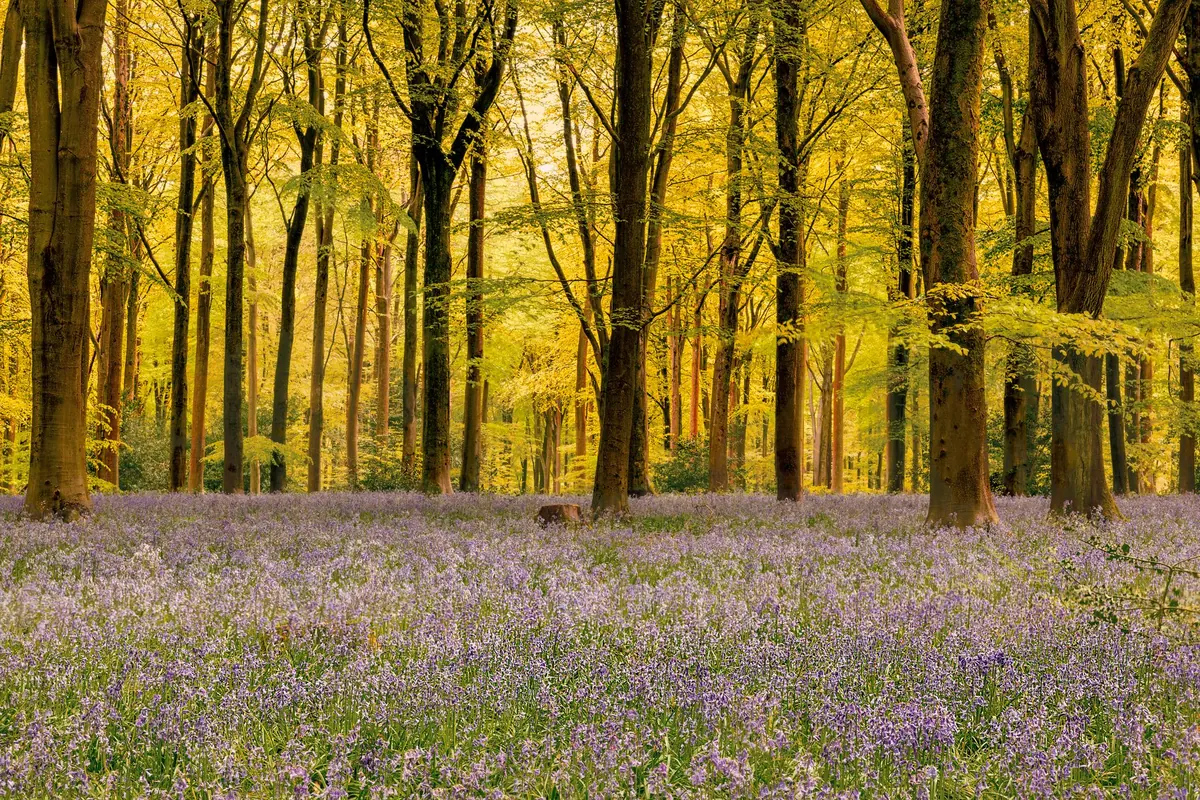
Spring moves faster than any other season and rewards weekly visits. Budburst, bluebells, wild garlic and the first ferns each last a matter of days to a couple of weeks, and the timing shifts with altitude, aspect and the year's weather. Shoot into the light for translucent leaves, keep contrast gentle, and get low for woodland flowers rather than photographing down at them.
High summer is the hardest season for the wide view. The canopy closes, the light goes hard by eight in the morning, and the wood becomes a green box. Arrive at first light, when mist sits in the rides and the low sun rakes across the undergrowth. When the light is flat and bright, abandon the wide shots and work close: ferns uncurling, bark texture, foxgloves against shadow. A rain shower is an invitation, not a reason to leave.
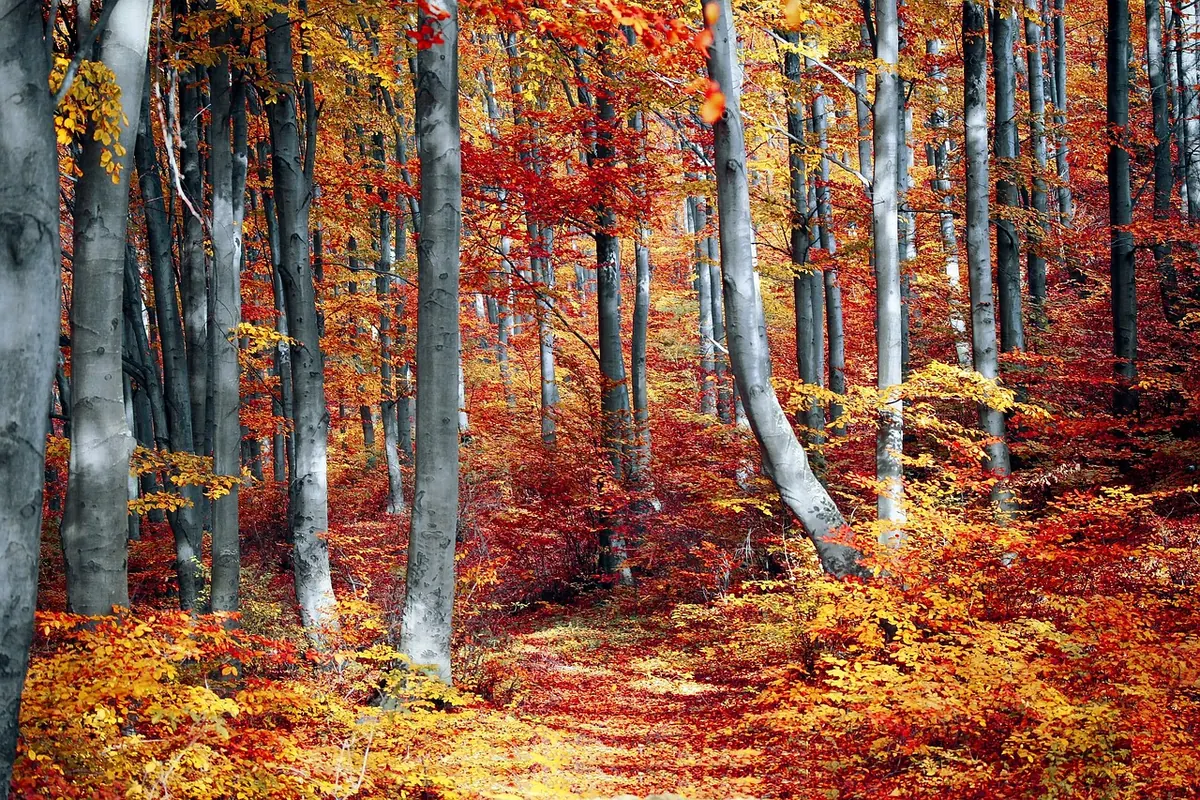
Colour is a short, unpredictable event — a fortnight of gold, then a gale and it is over. Watch the forecast and go when fog is forecast, not after. Wind is the enemy of sharp leaves; either wait for stillness or use it deliberately with a slow shutter to smear the canopy. Once the leaves are down, the wood becomes legible again: paths reappear, structures emerge, and the low sun reaches into places it has not touched since April.
Winter gives you what the other seasons hide. Branch architecture, the shape of the land, animal tracks, frost on dead wood, the true colour of bark. Snow is rare enough that it should override any plan — go the same day, early. Otherwise shoot silhouettes against bright sky, look for evergreens and fungi, and expect to work with cold hands and slow fingers. Take spare batteries inside your jacket and turn back before you get properly cold.
Four seasons is a tidy framework, but the real variety lives in the weather. The same viewpoint in fog, in hard frost, in slanting rain and in flat overcast will give you four genuinely different photographs, even within a single week. Build weather into the project rather than waiting for perfect conditions: if it rains, go and shoot wet bark and reflections. If there is a storm warning, visit the day after and photograph what has fallen.
Keep a simple log — date, time, weather, what you shot, what you noticed. A notebook or a phone note is enough. After a year, that log becomes the caption sheet for the series and reminds you which conditions you have already covered and which gaps remain.
A series reads as a series when the eye can recognise the recurring frame. Return to each anchor point from the same position and height: same lens, same tripod height, same rough framing. A mid-range zoom set to one focal length, or a single prime, prevents the slow drift towards whatever lens flatters the scene that day. Fix your white balance rather than leaving it on auto, shoot raw, and resist the urge to tidy the frame — leave the fallen log where it lies, because its gradual decay is part of the story.
Consistency is the spine, not the whole body. For every locked-off wide view, add two or three frames of detail: a leaf, a texture, a small event. Those close images give the sequence rhythm and stop it becoming a set of postcards.
Process the whole year with one grade. The temptation is to warm autumn and cool winter, but that pulls the series apart. Aim for a neutral, honest palette and let the seasons supply the colour. Edit in passes: first cull ruthlessly, then pick the strongest frame from each anchor point for each season, then see what is missing.
Try two sequences before you settle. Chronological — spring through winter — is the natural read and shows change clearly. Grouped by viewpoint is often more revealing, letting a reader see one tree through four seasons in four frames. Whichever you choose, twenty to thirty images is usually enough; a series of eighty is a folder, not a story. Give each image a caption with date, time and weather, and the project explains itself.
Twelve visits over a year is a realistic minimum, and one visit in the first fortnight of each season keeps the project honest. Put the solstices and equinoxes in your calendar as prompts; they are not magic dates, but they break the habit of photographing only the obvious weeks. Keep a printed contact sheet of what you have so far, pinned up where you will see it, and mark the gaps. Charge batteries the night before rain is forecast, not the night before a free morning.
Above all, go when you are not in the mood. The visits that feel least promising — grey, mild, nothing happening — are often the ones that produce the connecting frames a series needs. A wood you know intimately will reward that patience in ways a new location never quite can.
Photo: Valiphotos / Pixabay